

Prepared for Power: Why Psychological Steadiness Must Be a Leadership Prerequisite
Jan 20, 2026We psychologically assess pilots, surgeons, frontline responders, and people entrusted with individual lives.
Yet in the twenty-first century, we routinely place people into positions of enormous power with little or no assessment of their capacity to hold that power steadily.
Political leaders with access to catastrophic decision-making.
Corporate executives whose choices affect millions of livelihoods.
Systems architects shaping economies, environments, and futures.
We assume intelligence, experience, ambition, or confidence are enough.
Increasingly, they are not.
What feels missing in many of our leadership structures is not competence, but psychological steadiness.

Power does not simply reveal character.
It amplifies nervous system patterns.
Research consistently shows that power can reduce empathy, distort perception, and insulate people from feedback. Under sustained pressure, without meaningful relational challenge, even well-intentioned leaders can become detached, reactive, or morally disengaged.
This is not about individual pathology.
It is about biology, psychology, and systems.
When power is held in chronically dysregulated environments, speed and certainty are rewarded. Reflection and relational accountability are sidelined. Short-term wins eclipse long-term consequence.
In these conditions, steadiness matters more than brilliance.
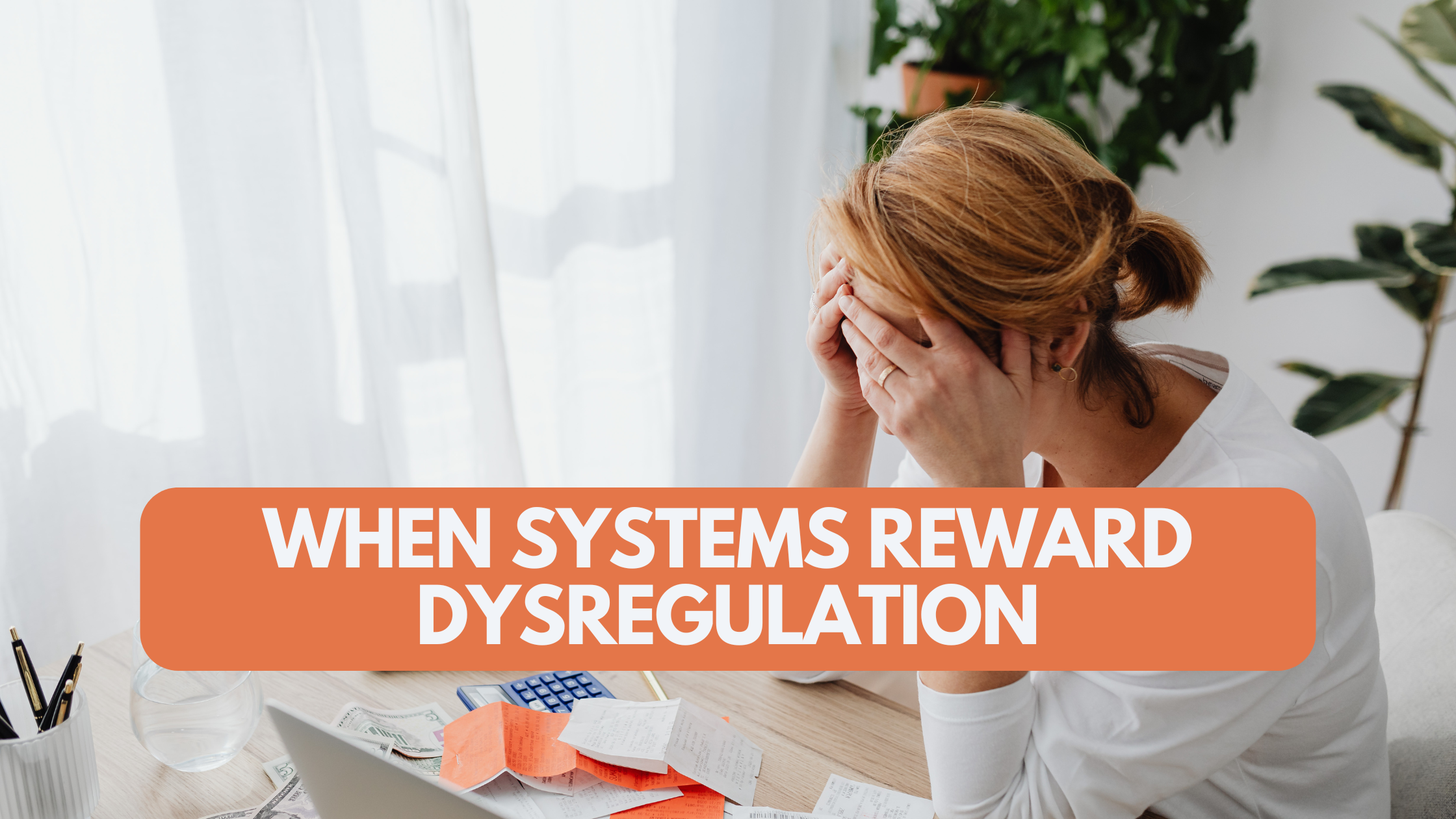
Many modern corporate and political systems inadvertently reward traits that look like strength but are often signs of dysregulation:
- Emotional detachment framed as objectivity
- Domination framed as decisiveness
- Relentless growth framed as success
- Risk without repair framed as courage
Over time, cultures form around these values. People who can tolerate moral distance rise faster. People who slow things down with questions about impact are marginalised.
This is not because leaders are inherently uncaring. It is because the system shapes behaviour.
Unchecked, these environments can amplify narcissistic or antisocial traits, or gradually pull ordinary humans into patterns of dehumanisation.
Power does not just attract dysregulation.
It can deepen it.

We still carry a cultural myth that strength means emotional invulnerability.
That the best leaders are those who are:
- Unshakeable
- Unaffected
- Relentlessly confident
- Immune to doubt
But psychological steadiness is not emotional numbness.
Steadiness is the capacity to remain present under pressure.
To tolerate uncertainty without collapsing into control.
To hear dissent without retaliation.
To repair when harm is caused.
To stay connected to consequence.
In reality, leaders who cannot feel are more dangerous than those who can.
What do we mean by psychological steadiness?
By psychological steadiness, I mean the ongoing capacity to remain regulated, relational, and ethically oriented under sustained responsibility and power.
It includes:
- Nervous system regulation under stress
- Capacity for self-reflection rather than defensiveness
- Tolerance of complexity and uncertainty
- Ability to receive feedback without humiliation or aggression
- Awareness of one’s relationship to power itself
- Commitment to repair, not just performance
This is not a pass or fail test.
It is a developmental capacity.
And it can be cultivated.
We are living in an era of converging crises: social, environmental, economic, psychological.
Decisions made in boardrooms and cabinets are increasingly disembodied from their human and planetary impact. The distance between decision and consequence has grown too wide.
In these conditions, power without steadiness becomes a risk factor.
Not just to individuals, but to:
- Organisational cultures
- Public trust
- Mental health at scale
- Ecological sustainability
- Social cohesion
This is why leadership cannot be treated purely as a performance role. It is a relational and ethical responsibility.
Return on Regulation at scale
In my work, I often speak about Return on Regulation. The idea that regulated nervous systems create better outcomes, not just kinder ones.
At a leadership level, this looks like:
- Fewer reactive decisions
- Less scapegoating and blame
- More sustainable strategies
- Cultures that can adapt rather than fracture
- Organisations that retain humanity under pressure
Regulation is not a soft skill.
It is a safety mechanism.
When leaders are steady, systems stabilise around them. When they are not, instability cascades downward.
From domination to stewardship
Perhaps the most important shift we need is a reframing of leadership itself.
From domination to stewardship.
From extraction to responsibility.
From power as something to wield, to power as something to hold.
Stewardship requires steadiness.
It requires leaders who can stay present with complexity, resist the pull of short-term certainty, and remain connected to the people and ecosystems affected by their decisions.
This is not idealism. It is realism.

We cannot continue to place extraordinary power into human hands without attending to the psychological conditions required to hold it well.
Psychological steadiness is not a luxury or an optional extra.
It is a prerequisite for ethical leadership in a complex world.
In my work with leaders through The Voyage for Leaders, I see again and again that when regulation, reflection, and responsibility are prioritised, leadership changes. Decisions slow down. Cultures soften without weakening. Power becomes less brittle, less defensive, more human.
If we want healthier systems, we must become more discerning about what we reward, what we train, and what we expect of those at the top.
Power deserves more care than we currently give it.
And the future will depend on whether we are willing to evolve our definition of leadership accordingly.