
The 4P Protocol™
You encounter trauma every day.
Here's a framework that actually helps.
The 4P Protocol™ is a practical, evidence-based framework for frontline professionals who work with people under pressure, in crisis, or in distress. Simple enough to use in a 10-minute appointment. Powerful enough to change how your whole team operates.
Available as a 90-minute taster, half-day, or full-day training. In-person across the UK, Europe and US.
Virtual available. All pricing on enquiry.
12
Sectors
1,000+ Professionals
Trained
25+ Years
Experience
UK & US
Delivery
CPD
Accredited
You've been trained in your technical role.
But nobody trained you for this.
They can't answer your questions.
Frozen, silent, giving contradictory information. You need a statement, a response, a decision — and they can't give it to you. You don't know if they're uncooperative, stalling or something else entirely.

They're hostile or shut down.
Shouting, refusing to engage, or so flat you can't reach them. You're doing your best. It's not working. The situation escalates or stalls — and you take it home with you.

They agree to everything and do nothing.
Nodding, compliant, saying yes. But you're not sure anything is landing. You're not certain they're present. Or that the work is going anywhere.
These aren't difficult people. They're dysregulated people. And the difference matters — because one approach creates resistance, and the other creates change.
The 4P Protocol™ teaches you why this happens, what it means, and what to do about it.
The 4P Protocol™ —
Four questions. One framework. Immediate application.
P1 — Protection
"Am I creating felt safety right now?"
Frozen, silent, giving contradictory information. You need a statement, a response, a decision — and they can't give it to you. You don't know if they're uncooperative, stalling on purpose or something else entirely.
What professionals learn:
- How to use calm, steady presence to create psychological safety
- Language that communicates "you're safe here" without saying it directly
- How to position yourself, pace interactions, and reduce threat cues
- Environmental factors that escalate or de-escalate
P2 — Prevention
"Am I doing no further harm?
Well-meaning professionals inadvertently retraumatise people every day — by pushing too hard, too fast, or using language that triggers shame or threat. Prevention is about timing, pace, and the questions you ask.
What professionals learn:
- How to use calm, steady presence to create psychological safety
- Language that communicates "you're safe here" without saying it directly
- How to position yourself, pace interactions, and reduce threat cues
- Environmental factors that escalate or de-escalate
P3 —Presence
"Am I co-regulating or reacting?"
Your nervous system is the most powerful tool in the room. Nervous systems are contagious — when you're regulated, the person in front of you begins to regulate too. This isn't soft. It's neuroscience.
What professionals learn:
- How to regulate yourself before and during difficult interactions
- Why your calm presence is more powerful than any script or procedure
- How to tolerate silence, sit with distress, and witness without rescuing
- What to do when you're dysregulated and need to reset
P4 — Possibility
"Am I offering agency and hope?"
Trauma strips agency. People who have experienced it often feel powerless, trapped, and invisible. Returning even tiny choices — where to sit, when to start, what happens next — communicates that they matter and that they have a say.
What professionals learn:
- How to offer genuine choice, even in constrained situations
- Language that empowers rather than directs
- How to give realistic hope without toxic positivity or false promises
- How to close an interaction in a way that leaves someone resourced, not depleted
Choose the right format for your team.
All training is delivered in-person (UK or US) or virtually. All formats include sector-specific examples and a participant workbook. Bespoke programmes available for organisations with specific requirements.
Format 1 — 90-Minute Taster Session
90 Minutes | Virtual or In-Person | Ideal for: Leadership teams, staff meetings, lunch-and-learns
An introduction to the 4P Protocol™ — what it is, why it matters, and what your team can start using immediately. Perfect for organisations that want to understand the approach before committing to a deeper programme, or for senior leadership awareness sessions.
Includes:
• Introduction to the 4P Framework
• Why behaviour is communication — and what it's communicating
• Two practical tools your team can use in their next interaction
• Q&A


Format 2 — Half-Day Workshop (3.5 hours)
3.5 Hours | In-Person or Virtual | Ideal for: Frontline teams, multi-disciplinary groups
The complete 4P Protocol™ framework, with practical application throughout. Participants leave with a full understanding of the four principles, a language toolkit, and immediate tools they can use the next day.
Includes:
- The complete 4P Protocol™ framework
- Neuroscience of trauma and the five survival responses
- Practical activities and real-world scenarios
- Language swaps — what NOT to say and what to say instead
- Sector-specific examples throughout
- Participant workbook and digital resources
Format 3 — Full-Day Training (6 hours)
6 Hours | In-Person Recommended | Ideal for: Organisations embedding trauma-informed culture
The most comprehensive 4P Protocol™ training. Everything in the half-day, plus extended practice, small group work, case studies from your sector, and a practical plan for embedding the 4Ps in your organisation's day-to-day operations.
Includes everything in the half-day, plus:
- Extended role-plays and practice scenarios
- Small group work and peer reflection
- In-depth case studies from your specific sector
- Integration and implementation planning
- Action plans for embedding the 4Ps in daily practice
- Certificate of completion

In-person delivery is strongly recommended for the full-day format — the practice and role-play elements are significantly more effective in the room.
Bespoke Training Need something tailored to your organisation?
We design bespoke training for organisations with specific sector requirements, complex team structures, or multi-day programmes. We also work with organisations on longer-term culture change — not just a training day, but an embedded shift in how your people respond to distress.
Book a ConversationA simple framework to help you understand the core principles behind your journey.
The 4P Guide is designed to give you a clear and practical overview of the key steps that support your progress. It breaks everything down into easy-to-follow concepts so you can apply them in real life with confidence.
Download your guide to get started.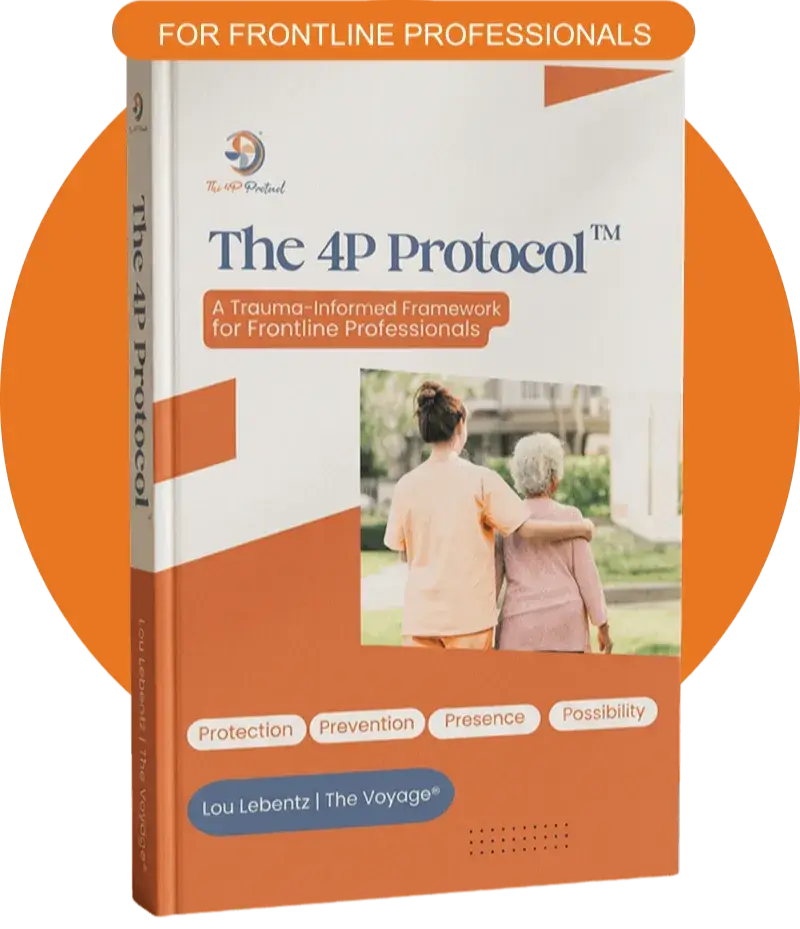
What your team will be able to do after training.
- Recognise the five survival responses — fight, flight, freeze, flop, fawn — and understand what each one needs
- Create felt safety in any professional interaction, regardless of setting or time pressure
- Avoid inadvertently retraumatising the people they're trying to help
- Use their own regulated nervous system as a de-escalation tool
- Understand co-regulation as a vital component in crisis situations
- Ask questions and use language that builds trust rather than causing harm
- Work effectively with fragmented memory, non-linear timelines, and apparent non-cooperation
- Offer genuine agency to people who feel powerless
- Recognise and manage their own vicarious trauma and compassion fatigue
- Apply the 4P framework in any sector, any setting, any time pressure
Built for the sectors where it matters most.
The 4P Protocol™ has been developed with sector-specific content for 12 professional areas. Every training session uses examples, scenarios, and language tailored to your team's actual working context.

Sector 1 — Police & Criminal Justice
Police officers, detectives, victim support, witness care, court staff
When someone is in a trauma response, they cannot give you a linear timeline. The 4Ps help you get better information, build cooperation, and take statements without causing further harm.

Sector 2 — Healthcare & Emergency Services
GPs, A&E staff, paramedics, nurses, mental health teams, urgent care
Your "heartsink" patients aren't difficult. They're dysregulated. The 4Ps help you understand psychosomatic presentations, de-escalate aggression, and treat the person — not just the symptoms.

Sector 3 — Education
Teachers, teaching assistants, SEN staff, pastoral care, school leadership
That "naughty" child isn't choosing to misbehave. They're communicating. The 4Ps help you see behaviour as information — and respond in ways that actually help, rather than escalate.

Sector 4 — Social Work
Children's services, adult safeguarding, child protection, community support
When families are hostile or won't engage, it's usually fear — not defiance. The 4Ps help you build trust with people who have every reason not to trust systems, and make better assessments as a result.

Sector 5 — Legal Professionals
Solicitors, barristers, legal advocates, family law, immigration, paralegal
Clients in trauma cannot give you a linear timeline, and compliance isn't the same as genuine informed consent. The 4Ps help you get real engagement, build trust, and prepare clients for court without retraumatising them.

Sector 6 — Journalism & Media
Journalists, reporters, editors, documentary makers, investigative media
"How did that make you feel?" is often the worst question you can ask. The 4Ps help you interview trauma survivors ethically — getting powerful stories without causing further harm or leaving your sources worse off.

Sector 7 — Financial Services & Wealth Management
Wealth managers, financial advisors, private banking, debt and benefits advisors
Financial crisis, sudden wealth, and bereavement all create trauma responses. The 4Ps help you recognise when a client cannot make informed decisions — and how to work with them, not around them.

Sector 8 — Frontline Community & Housing Services
Housing officers, homelessness services, foodbank workers, domestic violence support
The people who most need your help are often the hardest to reach. The 4Ps give you a framework for building trust with people who have been failed by systems before — and keeping yourself well in the process.

Sector 9 — Humanitarian & Crisis Response
Aid workers, disaster response, refugee and asylum support, crisis negotiators
You can't fix the crisis. But you can be present, build trust, and not cause further harm. The 4Ps help you stay regulated in the most extreme environments — and protect yourself from the cumulative cost of the work.

Sector 10 — Criminal Justice Settings
Probation officers, prison officers, youth offending teams, court staff
Most offenders are also victims. When you understand criminal behaviour as a trauma response — not a moral failure — everything about how you work changes. The 4Ps help you build real engagement and reduce reoffending.

Sector 11 — Perinatal & Early Years
Midwives, health visitors, nursery workers, childminders, family support
Birth trauma is real. Postnatal depression is a trauma response. The 4Ps help you support families through the most vulnerable period — recognising distress early, responding safely, and building the attachment that protects children long-term.

Sector 12 — Foster Care & Looked-After Children
Foster carers, residential care workers, kinship carers, care leavers support
Every child in care has experienced trauma. That's why they're in care. The 4Ps help you understand behaviour as communication, build trust with children who have learned not to trust, and prevent the placement breakdowns that cause yet more harm.
Trusted by frontline professionals across sectors.
The 4P Protocol™ has been developed with sector-specific content for 12 professional areas. Every training session uses examples, scenarios, and language tailored to your team's actual working context.
"The 4P Protocol completely changed how I take statements. I get better information, people cooperate more, and I feel less drained at the end of my shift."
— Detective Inspector, CID
"Finally, a framework that actually makes sense for 10-minute GP appointments. I can be trauma-informed without spending an hour with each patient."
— GP, NHS Primary Care
"Understanding behaviour as communication rather than defiance has transformed my classroom. The "naughty" kids aren't naughty — they're dysregulated. Now I know what to do."
— Year 5 Teacher
"I used to take hostility personally. Now I understand it's fear. The 4Ps help me slow down, build trust, and get real engagement. My assessments are better and I'm not burnt out."
— Children's Social Worker
"Understanding trauma changed how I prepare clients for court. I'm getting better engagement, clients trust me more, and I'm not taking the emotional weight home."
— Family Law Barrister
"Working in refugee camps, the 4Ps keep me grounded. I can't fix the crisis. But I can be present, build trust, and not cause further harm. That matters."
— Humanitarian Aid Worker
What changes when your team trains in the 4P Protocol™.
For Organisations
- Reduction in complaints and escalations
- Improved cooperation and engagement from service users
- Decreased staff sickness and turnover
- Better case outcomes and assessments
- A shared language across teams and agencies
- A foundation for genuine trauma-informed culture — not just awareness
For Individual Practitioners
- Immediate practical tools to use in their next interaction
- Confidence working with "difficult" or dysregulated behaviour
- Reduced stress, compassion fatigue, and end-of-day depletion
- Better professional relationships and communication
- Protection from vicarious trauma over the long term
- A universal language and approach to use with other team members
Frequently Asked Questions
We're not a clinical organisation. Is this relevant to us?
How is this different from other trauma training?
How long does training take?
Can this be delivered virtually?
How many people can attend?
Can this be funded through our training budget?
Do you offer training for multi-disciplinary teams from different sectors?
Do participants receive a certificate?
Can you come to our location?
Ready to transform how your team responds to distress?
Book a no-obligation conversation to discuss your training needs. We'll recommend the right format for your team, your sector, and your organisation.
Not ready to book yet? Why not download the free Trauma-Aware Professional guide and see the 4P framework in action
— then reach out when you're ready.