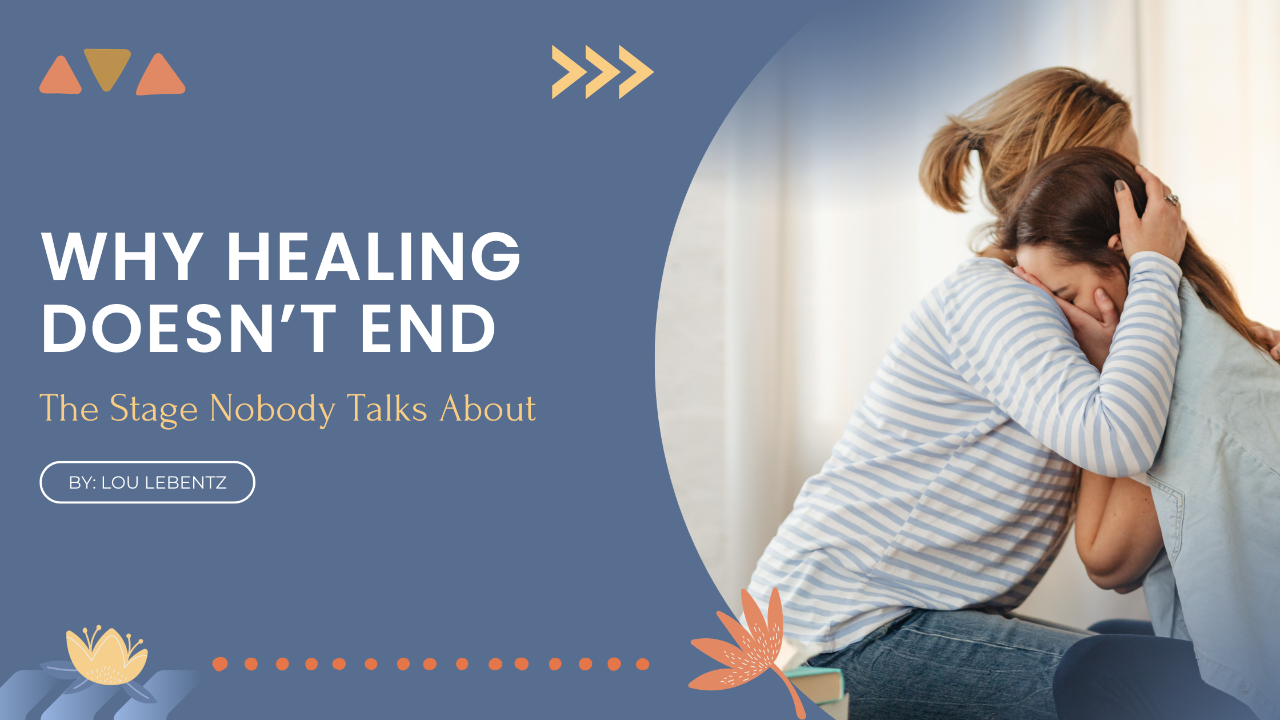
Why Healing Doesn’t End: The Stage Nobody Talks About
Mar 05, 2026For many years the conversation around healing has focused on the early stages.
The moment of recognition.
The realisation that something in our lives is not working.
The courage to begin looking more closely at our patterns, our histories, and the ways we have adapted to difficult experiences.
Those early stages are often intense.
There is learning.
There is relief.
Usually, there is grief as we begin to understand things we previously didn’t have language for.
And much of the personal growth industry is built around that moment of awakening.
But there is another stage of healing that receives far less attention.

After the crisis has softened.
After life becomes more stable.
From the outside, things may even look as though they are “sorted”.
Yet internally something quieter begins.
A different set of questions starts to appear.
Not:
“What is wrong with me?”
But:
“Who am I becoming now?”

Because many of the structures that organised our earlier healing begin to loosen.
The labels that once helped us make sense of our experience no longer feel quite as precise.
The identities we formed in response to difficult circumstances start to feel incomplete.
And the urgency to fix ourselves gradually fades.
What remains is something more reflective.
Of recognising the identities we carried for years and gently questioning whether they still need to define us.
Of learning to live with greater awareness rather than constantly searching for the next breakthrough.
This is not the stage of healing that gets marketed.
It is slower.
Less dramatic.
And in many ways more mature.
It is where growth stops being about transformation and becomes more about participation.
Participation in the way we respond to the people around us.
Participation in the ongoing process of becoming a little more honest, a little more aware, a little more responsible for the impact we have.
There is something quietly relieving about recognising this stage.
Because it removes the pressure to arrive somewhere final.
It allows healing to be understood as an ongoing relationship rather than a destination.
We are not finished versions of ourselves.
We are human beings living inside an unfolding process.
And perhaps maturity is not the moment when the work ends.
Perhaps it is the moment when we stop trying to complete ourselves and begin learning how to live consciously within the life we have.
Knowing that in each and every way, we are all on a path of unfolding, or what I call "continuous becoming".