
FREE GUIDE FOR FRONTLINE PROFESSIONALS
Responding to people in distress — without retraumatising them, and without burning out.
A free guide to the 4P Protocol™: a simple, memorable framework for trauma-informed first response. Built for the people who meet trauma in real time — in policing, healthcare, education, social work, housing, legal and professional services, and crisis response.
Download the Free Guide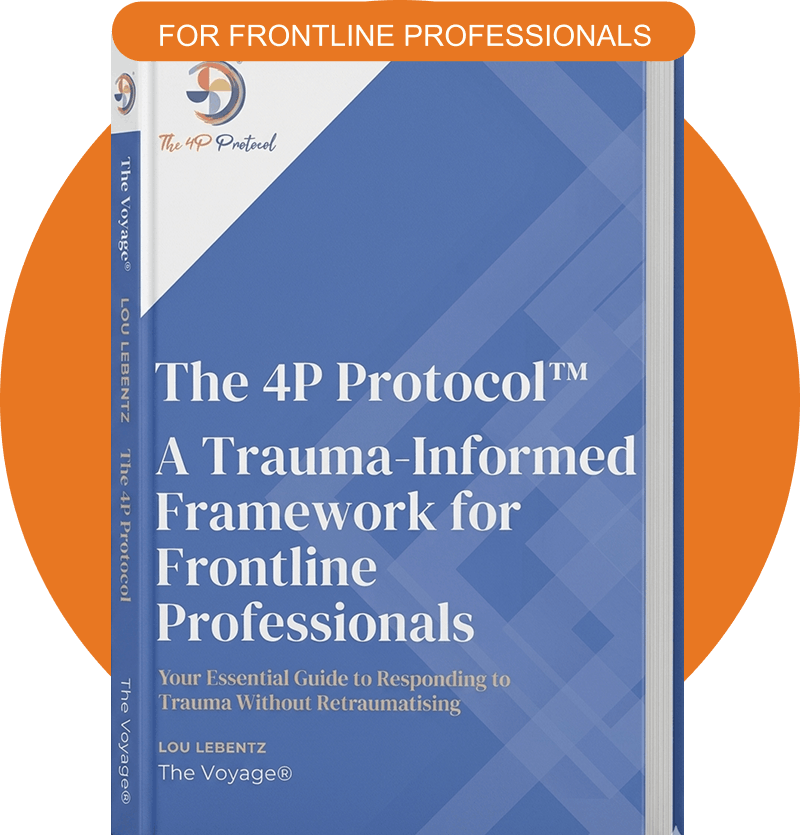
We meet trauma every day.
Most of us were never trained for it.
We are trained thoroughly in our technical roles — how to take a statement, run an assessment, treat an injury, hold a classroom, and lead a team. But trauma training, the kind that explains how it lives in the nervous system, why people “don’t cooperate,” how to avoid making things worse, and how to stay regulated under pressure — that is rarely part of the picture.
So the gap shows. A question asked at the wrong moment. Behaviour misread as defiance or dishonesty. Frustration with a “difficult” person. A sense of helplessness when nothing seems to land. And, in time, the quiet accumulation of all of it that we sometimes call burnout.
None of this is a personal failing. Most of us simply weren’t given these tools.
The 4P Protocol™ Guide is one small starting point for putting that right.
A practical framework you can begin to use in your very next conversation
The free guide is a substantial, practical mini-guide — not a thin download. Inside, you’ll find:
- What trauma actually is — and why it can show up as behaviour that’s easy to misread.
-
A working understanding of the nervous system — the survival responses, the window of tolerance, and why a person in distress genuinely cannot "just calm down."
-
The 4P Protocol™ — Protection, Prevention, Presence, and Possibility, explained simply, with worked examples from real frontline situations.
-
Language that tends to help, and language that can quietly harm — with side-by-side swaps to draw on straight away.
-
Ways to recognise and tend to vicarious trauma — in ourselves, and in the people we work alongside.
It won’t teach diagnosis or treatment, and it isn’t asking anyone to take on a therapeutic role. Trauma-informed practice is not about doing more — it’s about doing what we already do, a little differently.
Written for two readers
If you work on the frontline
Police, paramedics, GPs and nurses, teachers, social workers, housing officers, legal advocates, helpline and crisis staff — anyone meeting distress in real time. You’ll find a framework to draw on straight away in your next shift and conversation.
If you lead a team
Managers, service leads, and senior leaders will also find a shared language and a set of standards to build a culture around — and an honest look at what it takes to keep a team well in trauma-exposed work.
Get the free 4P Protocol™ Guide
Add your details and we’ll send the guide straight to your inbox. It’s free, and yours to keep, print, and share with your team.
We will email you the guide and occasional resources from The Voyage®. Unsubscribe any time.
Knowing the framework and embodying it are two different things
The guide offers the map. But reading about co-regulation isn’t the same as feeling, in our own body, what it’s like to stay regulated while someone in front of us is not.
That shift — from understanding the 4Ps to living them under pressure — is what training is for. The Voyage® offers the 4P Protocol™ as live, practice-based training, for individuals and for whole teams, with versions tailored to specific sectors.
Where the guide offers the map, the training is where the framework becomes embodied:
- Deeper neuroscience — the brain–body loop, the survival responses, and the window of tolerance, explored in enough depth to change how we read a room.
- Real practice — role-plays, partner exercises, and case studies drawn from our own sector.
- Our own nervous system — guided work on our own window, warning signs, and regulation, because co-regulation is something we can only offer if we’ve practised it ourselves.
- Integration and sustainability — honest attention to vicarious trauma, boundaries, and staying well in this work for the long term.
For organisations, the 4P Protocol™ can be delivered as a shared foundation across a whole team or service — the beginning of a genuinely trauma-informed culture, rather than a one-off course. In-person delivery is available in the UK and the US.
Bring the 4P Protocol™ to your team
For teams and organisations
A no-pressure conversation about bringing the 4P Protocol™ to your team or service — what it would look like, and what it would take.
Book a ConversationIf you lead a team
Register your interest to hear first when open 4P Protocol™ training dates are released.
Register InterestThe Voyage® is accredited by the CPD Standards Office.
About The Voyage®
The 4P Protocol™ was created by Lou Lebentz — Trauma-Informed Systems Designer, international speaker, and creator of The Voyage®.
The Voyage® is a trauma-informed training and systems-change organisation. It works with policing and criminal justice, healthcare, education, social work, legal and professional services, and humanitarian and crisis response — equipping individuals and whole organisations to meet trauma with safety rather than harm.

How you show up in the first few minutes changes everything that follows.
Start with the free guide. It’s yours to keep, print, and share.
Download the Free Guide-
Regulation before Revelation.
-
Safety before Story.
-
Compassion before Correction.
-
Presence before Perfection.

Programmes
Voyage for Leaders™
4P Protocol™
Essentials Non-Clinical
TAPT Non-Clinical
Essentials Clinical
TAPT Clinical
Masterclasses
The Deep Dive
Clinics & Rehabs
Resources & Community
Free Ebooks & Tools
Events & Webinars
Continuous Becoming
Insights & Blog
Newsletter
The Academy
About Lou
Meet the Team
Meet the Trainers (Coming Soon)
Ethos of The Voyage®
Contact